How Seed Saving Can Save the Environment
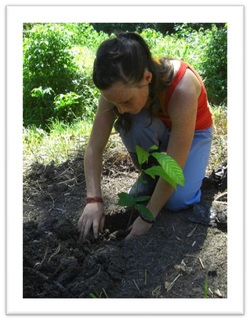
Kristina Buckingham, Major: International Studies and Spanish, Hometown: Salt Lake City, UT
I love food. I love everything about food. I love the way it looks, I love the way it smells, I love cooking it, I love eating it, and I love learning about it. Growing up in the middle of a city, though, I never really knew where my food came from (with the exception of the delicious tomatoes and herbs from my mother’s garden) until I started investigating it myself. That’s when I entered the shocking world of today’s industrial agriculture system. It’s hard to look at a meal, or even just a cup of coffee, the same way once you know more about the conditions it was grown under. What I’ve learned about agriculture, its history and present state, in the past few years has seriously changed my outlook on food. I’ve realized that as a (very) avid consumer of food, I have a responsibility to my own health, to farmers around the world, and to the environment to put my knowledge into practice in my own life, starting with my food choices.
Last week, Summer posted about how “Saving Seeds Can Save Us All. ” From her article, we know that on top of being seriously hazardous to our health (see Nicole’s article), GM foods and the industry giants like Monsanto that control them are ruining the livelihoods, and lives, of farmers across the world. The monopolization of seeds is resulting in a suicidal economy for the farmers who are losing their livelihood, for the people who are losing their food source, and for the human species, as we destroy the natural resources that we depend upon for our survival: our clean water, our fertile soil, our biodiversity, our atmosphere, and our seeds.
Saving Seeds can Save the Environment
OK, so that’s a pretty bold statement. Let’s start a little bit closer to home.
Do You Remember…
That first kindergarten or elementary school project where your teacher brought in seeds from an apple or a pumpkin and each student got to plant their own seed in a Dixie cup with a little bit of soil and a sprinkle of water? Do you remember the excitement of the day when you finally saw a tiny curl of green stem pushing its way through what was just plain brown dirt the day before? For most of us who grew up in cities, that might have been our first exposure to the magic of the infinite life cycle of plants. I remember running home from that day in class and planting every seed I could get my hands on from the refrigerator. I grew sprouts from peppers, avocados, tomatoes, and cucumbers in the next few months, just by taking the seeds out of each fruit, sticking them in the dirt, and giving them a little bit of TLC.
How about a quick biology lesson?
Saving seeds from harvests to use again from year to year is the traditional way that farms and gardens were maintained for centuries. The process of open-pollination and replanting seeds from crops is the most natural thing in the world. As a farmer, it’s a no-brainer; one of your biggest business inputs—seeds—is already in your hands when you harvest your crop. In addition to that, though, the process of saving seeds from the best performing crops to plant again the next season is a form of reproduction through natural means that allows the plants to adapt to their local conditions over time. In other words, farmers would save natural heirloom seeds (as opposed to GM seeds) from the most suitable (i. e. biggest, healthiest, sweetest) plants and plant them again the next year. The saved seeds would gradually evolve over several growing seasons to cope with local conditions like the soil, moisture levels, and temperatures. The evolution of these seeds helped them perform better and more reliably in the conditions to which they had adapted (Wikipedia). Most of us know something about Darwin’s theory of evolution…well, there you go. Seed saving is a form of natural selection. Key word: natural.
Our modern agriculture system, on the other hand, is anything BUT natural. The seeds sold today by Monsanto and other industry giants are seeds that have been hybridized and cloned in science labs, artificially cross-pollinated to have specific characteristics, like higher yield or uniform color (Wikipedia). Monsanto’s infamous “Roundup Ready” crops exist because the company found a way to alter the DNA of the seeds to allow them to withstand certain chemical herbicides (SourceWatch). Does that sound natural to you?
The built-in sterility of GM seeds prohibits seed saving practices, instead forcing farmers to buy new seeds each year from Monsanto. This effectively negates the evolutionary process of crops adapting to local conditions. The constant use of crops that haven’t been allowed to adapt to local conditions has caused a huge number of problems. We’ve already talked about the health consequences of our diets of these unnatural, genetically modified foods. We’ve also discussed how the increased yields advertised by Monsanto don’t meet their promises (in large part because the seeds are not adapted to local conditions), and the effect that has had on farmers in the U. S. and across the world. But what effect does the conventional food and seed system have on the environment?
Biodiversity Loss
We learned last week about the legal problems farmers were experiencing because of cross-pollination in their crops from genetically modified seeds. The damage from cross-contamination of GM seeds doesn’t end with the farmers, unfortunately. Cross-pollination of plants in neighboring fields is natural and inevitable, as seeds are carried by the wind or by birds and other animals from one place to another. In the past, this hasn’t been as much of a problem, since most farmers were growing similar crops in natural ways. In contrast, the contamination today of natural and organic plants by GMOs causes irreversible damage to the organic crop.
GMOs aggressively cross-contaminate neighboring organic plants, causing incalculable damage. An unapproved GM rice grown only for one year in field trials was found to have caused extensive contamination of the US rice supply. A Spanish study found that GM maize “has caused a drastic reduction in organic cultivations of this grain and is making their coexistence practically impossible”. (Rain, 2011)
In most cases, cross-pollination by genetically modified plants results in the contamination and loss of the organic variety. The world used to have a vast gene pool of crops, with thousands of different varieties of each plant, as a result of seed saving over generations and the evolution and adaptation of crops to unique locations. The take-over of GM crops across the world since the Green Revolution has eroded this gene pool by contaminating and eliminating the varieties, resulting in a loss of the adaptive and hardy traits of local varieties of crops.
The erosion of the gene pool is referred to as “biodiversity loss” and has far-reaching implications for the environment and the human species, including, as we’ve seen, impacting our ability to feed ourselves and future generations.
Soil
Those of us inexperienced with farming may picture the Dixie cup experiment from elementary school, thinking that you can just throw a seed in some soil and sprinkle water on top of it, and out pops an ear of corn. We know that the water and the seed quality are important but the dirt is just what it grows out of. Dirt is dirt, right? WRONG.
Soil is an ecosystem on its own, providing plants with the nutrients that they need to grow. The natural relationship between soil and plants is a mutually beneficial one, where they exchange nutrients to keep one another healthy. Since different crops have different nutrient needs, traditional planting systems used ideas of permaculture and crop rotation, which diversified the nutrients being given to the soil and taken from it. These practices ensured that the soil was never leached of its nutrients completely.
Somehow, the science behind those practices seems to have been conveniently forgotten by today’s conventional agriculture industry. Instead of rotating crops each season or planting partner crops together, our agriculture industry sows giant fields with a single variety of a GM crop season after season, for maximum profitability.
By practicing mono-cropping year after year, farmers are seriously depleting the nutrients in their soil, and therefore eliminating the ability of their soil to act as a healthy ecosystem for crops. In addition to problems like erosion and drying out of land, declining soil quality and health forces farmers to increase use of chemical fertilizers, since the soil can no longer provide the plants with the nutrients they need.
Chemical Fertilizers, Pesticides, and Herbicides
This category may be the biggest complaint against GM crops from health, human, and environmental standpoints, and it is certainly one of the greatest threats posed by Monsanto and other agricultural giants. As discussed above, mono-cropping practices (as well as unnatural crops) deplete soil health, forcing farmers to use chemical fertilizers for their crops to yield. Even more problematic, though, are the GM crops, like Roundup Ready crops, specifically designed to be resistant to chemical pesticides and herbicides. This incites farmers to use more and more chemical pesticides and herbicides on their crops (surprise: these products are also created and sold by Monsanto).
The overuse of these chemicals has led to the growth of “superweeds” that are resistant to the herbicides used against them. Monsanto’s solution has been to develop new products with even more toxic chemicals (Occupy Monsanto, n.d.).
The hugely increased use of chemical fertilizers, pesticides, and herbicides since the adoption of GM crops doesn't just affect our personal health (although I’d say that’s a pretty good reason in itself to pay attention). The chemicals used in farming kill the soil, leak into water sources, poisoning our rivers and groundwater, and cause devastating health problems in animal and human populations. The development and creation of these chemical inputs is also one of the leading causes of global climate change (McDermott, 2008).
Back to Nature
With all of that incredibly overwhelming and scary information in mind, it’s time to get back to where this all started. So, how CAN saving seeds save the environment?
Saving seeds takes us back to the traditional methods of farming, allowing plants to adapt to local conditions over time and evolve to grow better in their unique locations. Maintaining heirloom varieties of crops through seed saving prevents additional biodiversity loss. Used with crop rotation or permaculture techniques, seed saving and the use of a range of crop varieties avoid the problems of mono-cropping and keep soil healthy and productive. Finally, naturally evolved seed varieties will grow more reliably and with higher yields in their adapted environments than would GM seeds, eliminating (or at least drastically reducing) the need for chemical fertilizers, pesticides, or herbicides. (For healthy, natural, and organic alternatives to chemical pesticides/herbicides, check out this page). This in itself could reduce agriculture’s role in global climate change. Saving seeds may seem like a small way to address a HUGE problem, but as you can see, the effects of just that one small action could, really, save our environment.
So, what can we do?
I realize that the issues presented above can be hugely overwhelming. It’s easy to feel powerless in the face of such widespread problems. As always, though, we want to give you a few ideas of what you can do, on a global/national level, on a community level, and on an individual level to start to address these issues.
Global & National Level:
Community Level
Individual Level
Coming up next week, you’ll get to meet Brad with the last post of this series: How Saving Seeds Can Save America!
Works Cited
"Biohazards. " Occupy Monsanto. N. p. , n. d. Web. 13 Nov. 2012.
McDermott, Mat. "More Than Pretty Heirloom Tomatoes: Saving Seeds Critical to Combatting Climate Change. " TreeHugger. N. p. , 23 Sept. 2008. Web. 14 Nov. 2012.
Pearce, Fred. "Saving the Seeds of the Next Green Revolution. " Environment 360. Yale University, 22 Sept. 2008. Web. 10 Nov. 2012.
Rain, Lois. "5 Reasons NOT To Eat GM Foods. " Health Freedom Alliance. N. p. , 27 June 2011. Web. 10 Nov. 2012.
Shiva, Vandana. "The Seed Emergency: The Threat to Food and Democracy - Opinion - Al Jazeera English. " The Seed Emergency: The Threat to Food and Democracy. Aljazeera, 06 Feb. 2012. Web. 2 Nov. 2012.
SourceWatch Contributors. "Roundup Ready Crops. " SourceWatch. N. p. , 20 Sept. 2012. Web. 14 Nov. 2012.
Wikipedia contributors. "Seed saving. " Wikipedia, The Free Encyclopedia. Wikipedia, The Free Encyclopedia, 6 Aug. 2012. Web. 14 Nov. 2012.
I love food. I love everything about food. I love the way it looks, I love the way it smells, I love cooking it, I love eating it, and I love learning about it. Growing up in the middle of a city, though, I never really knew where my food came from (with the exception of the delicious tomatoes and herbs from my mother’s garden) until I started investigating it myself. That’s when I entered the shocking world of today’s industrial agriculture system. It’s hard to look at a meal, or even just a cup of coffee, the same way once you know more about the conditions it was grown under. What I’ve learned about agriculture, its history and present state, in the past few years has seriously changed my outlook on food. I’ve realized that as a (very) avid consumer of food, I have a responsibility to my own health, to farmers around the world, and to the environment to put my knowledge into practice in my own life, starting with my food choices.
Last week, Summer posted about how “Saving Seeds Can Save Us All. ” From her article, we know that on top of being seriously hazardous to our health (see Nicole’s article), GM foods and the industry giants like Monsanto that control them are ruining the livelihoods, and lives, of farmers across the world. The monopolization of seeds is resulting in a suicidal economy for the farmers who are losing their livelihood, for the people who are losing their food source, and for the human species, as we destroy the natural resources that we depend upon for our survival: our clean water, our fertile soil, our biodiversity, our atmosphere, and our seeds.
Saving Seeds can Save the Environment
OK, so that’s a pretty bold statement. Let’s start a little bit closer to home.
Do You Remember…
That first kindergarten or elementary school project where your teacher brought in seeds from an apple or a pumpkin and each student got to plant their own seed in a Dixie cup with a little bit of soil and a sprinkle of water? Do you remember the excitement of the day when you finally saw a tiny curl of green stem pushing its way through what was just plain brown dirt the day before? For most of us who grew up in cities, that might have been our first exposure to the magic of the infinite life cycle of plants. I remember running home from that day in class and planting every seed I could get my hands on from the refrigerator. I grew sprouts from peppers, avocados, tomatoes, and cucumbers in the next few months, just by taking the seeds out of each fruit, sticking them in the dirt, and giving them a little bit of TLC.
How about a quick biology lesson?
Saving seeds from harvests to use again from year to year is the traditional way that farms and gardens were maintained for centuries. The process of open-pollination and replanting seeds from crops is the most natural thing in the world. As a farmer, it’s a no-brainer; one of your biggest business inputs—seeds—is already in your hands when you harvest your crop. In addition to that, though, the process of saving seeds from the best performing crops to plant again the next season is a form of reproduction through natural means that allows the plants to adapt to their local conditions over time. In other words, farmers would save natural heirloom seeds (as opposed to GM seeds) from the most suitable (i. e. biggest, healthiest, sweetest) plants and plant them again the next year. The saved seeds would gradually evolve over several growing seasons to cope with local conditions like the soil, moisture levels, and temperatures. The evolution of these seeds helped them perform better and more reliably in the conditions to which they had adapted (Wikipedia). Most of us know something about Darwin’s theory of evolution…well, there you go. Seed saving is a form of natural selection. Key word: natural.
Our modern agriculture system, on the other hand, is anything BUT natural. The seeds sold today by Monsanto and other industry giants are seeds that have been hybridized and cloned in science labs, artificially cross-pollinated to have specific characteristics, like higher yield or uniform color (Wikipedia). Monsanto’s infamous “Roundup Ready” crops exist because the company found a way to alter the DNA of the seeds to allow them to withstand certain chemical herbicides (SourceWatch). Does that sound natural to you?
The built-in sterility of GM seeds prohibits seed saving practices, instead forcing farmers to buy new seeds each year from Monsanto. This effectively negates the evolutionary process of crops adapting to local conditions. The constant use of crops that haven’t been allowed to adapt to local conditions has caused a huge number of problems. We’ve already talked about the health consequences of our diets of these unnatural, genetically modified foods. We’ve also discussed how the increased yields advertised by Monsanto don’t meet their promises (in large part because the seeds are not adapted to local conditions), and the effect that has had on farmers in the U. S. and across the world. But what effect does the conventional food and seed system have on the environment?
Biodiversity Loss
We learned last week about the legal problems farmers were experiencing because of cross-pollination in their crops from genetically modified seeds. The damage from cross-contamination of GM seeds doesn’t end with the farmers, unfortunately. Cross-pollination of plants in neighboring fields is natural and inevitable, as seeds are carried by the wind or by birds and other animals from one place to another. In the past, this hasn’t been as much of a problem, since most farmers were growing similar crops in natural ways. In contrast, the contamination today of natural and organic plants by GMOs causes irreversible damage to the organic crop.
GMOs aggressively cross-contaminate neighboring organic plants, causing incalculable damage. An unapproved GM rice grown only for one year in field trials was found to have caused extensive contamination of the US rice supply. A Spanish study found that GM maize “has caused a drastic reduction in organic cultivations of this grain and is making their coexistence practically impossible”. (Rain, 2011)
In most cases, cross-pollination by genetically modified plants results in the contamination and loss of the organic variety. The world used to have a vast gene pool of crops, with thousands of different varieties of each plant, as a result of seed saving over generations and the evolution and adaptation of crops to unique locations. The take-over of GM crops across the world since the Green Revolution has eroded this gene pool by contaminating and eliminating the varieties, resulting in a loss of the adaptive and hardy traits of local varieties of crops.
The erosion of the gene pool is referred to as “biodiversity loss” and has far-reaching implications for the environment and the human species, including, as we’ve seen, impacting our ability to feed ourselves and future generations.
Soil
Those of us inexperienced with farming may picture the Dixie cup experiment from elementary school, thinking that you can just throw a seed in some soil and sprinkle water on top of it, and out pops an ear of corn. We know that the water and the seed quality are important but the dirt is just what it grows out of. Dirt is dirt, right? WRONG.
Soil is an ecosystem on its own, providing plants with the nutrients that they need to grow. The natural relationship between soil and plants is a mutually beneficial one, where they exchange nutrients to keep one another healthy. Since different crops have different nutrient needs, traditional planting systems used ideas of permaculture and crop rotation, which diversified the nutrients being given to the soil and taken from it. These practices ensured that the soil was never leached of its nutrients completely.
Somehow, the science behind those practices seems to have been conveniently forgotten by today’s conventional agriculture industry. Instead of rotating crops each season or planting partner crops together, our agriculture industry sows giant fields with a single variety of a GM crop season after season, for maximum profitability.
By practicing mono-cropping year after year, farmers are seriously depleting the nutrients in their soil, and therefore eliminating the ability of their soil to act as a healthy ecosystem for crops. In addition to problems like erosion and drying out of land, declining soil quality and health forces farmers to increase use of chemical fertilizers, since the soil can no longer provide the plants with the nutrients they need.
Chemical Fertilizers, Pesticides, and Herbicides
This category may be the biggest complaint against GM crops from health, human, and environmental standpoints, and it is certainly one of the greatest threats posed by Monsanto and other agricultural giants. As discussed above, mono-cropping practices (as well as unnatural crops) deplete soil health, forcing farmers to use chemical fertilizers for their crops to yield. Even more problematic, though, are the GM crops, like Roundup Ready crops, specifically designed to be resistant to chemical pesticides and herbicides. This incites farmers to use more and more chemical pesticides and herbicides on their crops (surprise: these products are also created and sold by Monsanto).
The overuse of these chemicals has led to the growth of “superweeds” that are resistant to the herbicides used against them. Monsanto’s solution has been to develop new products with even more toxic chemicals (Occupy Monsanto, n.d.).
The hugely increased use of chemical fertilizers, pesticides, and herbicides since the adoption of GM crops doesn't just affect our personal health (although I’d say that’s a pretty good reason in itself to pay attention). The chemicals used in farming kill the soil, leak into water sources, poisoning our rivers and groundwater, and cause devastating health problems in animal and human populations. The development and creation of these chemical inputs is also one of the leading causes of global climate change (McDermott, 2008).
Back to Nature
With all of that incredibly overwhelming and scary information in mind, it’s time to get back to where this all started. So, how CAN saving seeds save the environment?
Saving seeds takes us back to the traditional methods of farming, allowing plants to adapt to local conditions over time and evolve to grow better in their unique locations. Maintaining heirloom varieties of crops through seed saving prevents additional biodiversity loss. Used with crop rotation or permaculture techniques, seed saving and the use of a range of crop varieties avoid the problems of mono-cropping and keep soil healthy and productive. Finally, naturally evolved seed varieties will grow more reliably and with higher yields in their adapted environments than would GM seeds, eliminating (or at least drastically reducing) the need for chemical fertilizers, pesticides, or herbicides. (For healthy, natural, and organic alternatives to chemical pesticides/herbicides, check out this page). This in itself could reduce agriculture’s role in global climate change. Saving seeds may seem like a small way to address a HUGE problem, but as you can see, the effects of just that one small action could, really, save our environment.
So, what can we do?
I realize that the issues presented above can be hugely overwhelming. It’s easy to feel powerless in the face of such widespread problems. As always, though, we want to give you a few ideas of what you can do, on a global/national level, on a community level, and on an individual level to start to address these issues.
Global & National Level:
- Globally: Reward a shift back to organic farming techniques
- In the United States: Require Monsanto to accept responsibility for their environmental impact
Community Level
- Start or get involved with community seed saving and seed swapping organizations
- (Repeated from last week) Pass bills requiring GM foods to be labeled. Don’t you want to know what you’re eating? Putting labels on GM foods will decrease the power that these seed monopolies have over our food and our consumers!
Individual Level
- If you’re a gardener or farmer, buy your seeds from a natural, seed saving seller like one of thes
- If you’re not a gardener or farmer, try the Dixie cup project again. You may be amazed at how fulfilling it still is to witness that miracle of growth.
- Vote with your wallet. Be conscious of what you are consuming, and, whenever possible, support organic and natural food. It’s better for your health, too!
Coming up next week, you’ll get to meet Brad with the last post of this series: How Saving Seeds Can Save America!
Works Cited
"Biohazards. " Occupy Monsanto. N. p. , n. d. Web. 13 Nov. 2012.
McDermott, Mat. "More Than Pretty Heirloom Tomatoes: Saving Seeds Critical to Combatting Climate Change. " TreeHugger. N. p. , 23 Sept. 2008. Web. 14 Nov. 2012.
Pearce, Fred. "Saving the Seeds of the Next Green Revolution. " Environment 360. Yale University, 22 Sept. 2008. Web. 10 Nov. 2012.
Rain, Lois. "5 Reasons NOT To Eat GM Foods. " Health Freedom Alliance. N. p. , 27 June 2011. Web. 10 Nov. 2012.
Shiva, Vandana. "The Seed Emergency: The Threat to Food and Democracy - Opinion - Al Jazeera English. " The Seed Emergency: The Threat to Food and Democracy. Aljazeera, 06 Feb. 2012. Web. 2 Nov. 2012.
SourceWatch Contributors. "Roundup Ready Crops. " SourceWatch. N. p. , 20 Sept. 2012. Web. 14 Nov. 2012.
Wikipedia contributors. "Seed saving. " Wikipedia, The Free Encyclopedia. Wikipedia, The Free Encyclopedia, 6 Aug. 2012. Web. 14 Nov. 2012.
 RSS Feed