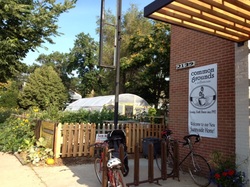
 Our farm is in a community of homes, businesses, bicyclists, walkers, birds, and city beasts. Building community is as important as building soil.
 There is a lot of conversation in our community lately about gentrification. As I putter in our vegetable beds, prune fruit trees and bushes, and plant for the season, I've been noticing how much tending to growing things can teach us about living together.
Sometimes we can forget that soil and communities are living things. They are like air and water, always surrounding us. It is important to take a moment to engage and observe whether our interactions are healthy, warranted, or even needed. Here are some things we can learn from sustainable farming and gardening.
Don’t assume something needs to be fixed: In the Springtime it is hard not to run out on the first sunny days to turn over soil. We feel strong and accomplished standing there with our shovel and pitchforks. Although we have been taught this by many generations (and countless advertisements!), we have known for a long time that the life and health of our soil’s ecosystem is immeasurably disturbed by unnecessary tilling and digging. This is not unlike the reaction of our North Denver community to the digging up and turning over of the lovely housing stock that defined our neighborhoods. Those who have been here for a while are in shock from the visual and emotional changes to our home. Like soil, it will take us a while to recover.
Healthy soil can be over fertilized: Many “miracles” are proclaimed in advertising during this crucial sales time in the gardening business. Here, again, we are being bombarded by the thought that something is inherently wrong with our soil so we add boosters every year – just in case. Without testing your soil and understanding its strengths and weaknesses, you can toxify it by assuming you know what’s best. Communities are the same. Without taking the time to explore and understand, even adding what you consider “good and miraculous” elements can end up creating a toxic environment.
No matter how good it might look, if the conductivity is not there no one benefits: In healthy humus there is a natural electrical conductivity, like static-cling, that attracts nutrients to clay making it available to plants for their food. Without this pull and interaction a plant can’t eat, even in a soil that seems to be a well-stocked with nutrients and minerals. Good humus comes from diversity of compost inputs, room for air, and patience as relationships develop and boundaries break down. Does that sound like good advice for a healthy community? I think it does!
It takes a few seasons to develop networks and understanding: Although I love seed catalogs as much as the next person, to truly develop healthy, strong plants and vegetables you need to save seeds and nurture them over the years. Hardly any seed on the market is actually grown in a high-mountain, arid landscape like ours. If the seed comes from Florida or Missouri it is in the nature and expectation of the plant growing from that seed to expect that environment. The plant will not fully express its full, juicy self until it has time (seasons) to acclimate to our climate. People are the same. It can take a while for a new person to find their way around, settle in, and begin showing their best self in the same way a current resident may feel invaded, shy, or not trusting. Gently developing relationships with respect and sharing goes a long way toward creating a strong community.
It is important on all sides of community – those that have been around for a while and those who have recently “blown in” – to be patient, get to know one another, seek to share strengths and minimize conflicts, and find reasons to work together and share knowledge and skills. Although there is a lot of frustration and bristling, judgments and assumptions, I know our community can create a healthy ecosystem if we practice patience and respect and take the time to get to know one another.
Sometimes we can forget that soil and communities are living things. They are like air and water, always surrounding us. It is important to take a moment to engage and observe whether our interactions are healthy, warranted, or even needed. Here are some things we can learn from sustainable farming and gardening.
Don’t assume something needs to be fixed: In the Springtime it is hard not to run out on the first sunny days to turn over soil. We feel strong and accomplished standing there with our shovel and pitchforks. Although we have been taught this by many generations (and countless advertisements!), we have known for a long time that the life and health of our soil’s ecosystem is immeasurably disturbed by unnecessary tilling and digging. This is not unlike the reaction of our North Denver community to the digging up and turning over of the lovely housing stock that defined our neighborhoods. Those who have been here for a while are in shock from the visual and emotional changes to our home. Like soil, it will take us a while to recover.
Healthy soil can be over fertilized: Many “miracles” are proclaimed in advertising during this crucial sales time in the gardening business. Here, again, we are being bombarded by the thought that something is inherently wrong with our soil so we add boosters every year – just in case. Without testing your soil and understanding its strengths and weaknesses, you can toxify it by assuming you know what’s best. Communities are the same. Without taking the time to explore and understand, even adding what you consider “good and miraculous” elements can end up creating a toxic environment.
No matter how good it might look, if the conductivity is not there no one benefits: In healthy humus there is a natural electrical conductivity, like static-cling, that attracts nutrients to clay making it available to plants for their food. Without this pull and interaction a plant can’t eat, even in a soil that seems to be a well-stocked with nutrients and minerals. Good humus comes from diversity of compost inputs, room for air, and patience as relationships develop and boundaries break down. Does that sound like good advice for a healthy community? I think it does!
It takes a few seasons to develop networks and understanding: Although I love seed catalogs as much as the next person, to truly develop healthy, strong plants and vegetables you need to save seeds and nurture them over the years. Hardly any seed on the market is actually grown in a high-mountain, arid landscape like ours. If the seed comes from Florida or Missouri it is in the nature and expectation of the plant growing from that seed to expect that environment. The plant will not fully express its full, juicy self until it has time (seasons) to acclimate to our climate. People are the same. It can take a while for a new person to find their way around, settle in, and begin showing their best self in the same way a current resident may feel invaded, shy, or not trusting. Gently developing relationships with respect and sharing goes a long way toward creating a strong community.
It is important on all sides of community – those that have been around for a while and those who have recently “blown in” – to be patient, get to know one another, seek to share strengths and minimize conflicts, and find reasons to work together and share knowledge and skills. Although there is a lot of frustration and bristling, judgments and assumptions, I know our community can create a healthy ecosystem if we practice patience and respect and take the time to get to know one another.
 RSS Feed
